Author: Maurilio Amorim

  • Are Non Profits Dying Because They Don’t Pay Well?

    My friend Wayne Elsey is an extraordinary guy. He has built one of the most successful non profit organization in the world. During the last 5 years, Soles 4 Souls has gone from 0 to over a 70-million dollar annual budget organization. I’m thankful to have been a partner from early on. My company, The A Group, has developed soles4souls.org and their online fund-raising site. Wayne has written a book I believe every leader should read, “Almost Isn’t Good Enough.” This is not only his story of starting and growing S4S, but a very practical tool for business and ministry leaders everywhere. Chapter 2 has stuck with me, and I can’t get it out of my mind: Build the Community You Want, Not the One You Can Afford.
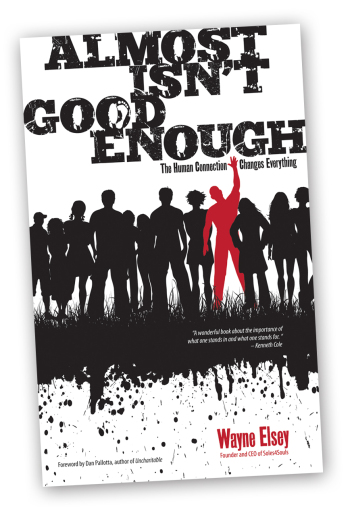
    According to Elsey, finding the best people for the job and hiring them at competitive wages (competitive with the market place and not other non-profits) is key in building a high performance organization. If you want to make an impact, find the best and pay them well.

    That hasn’t been the norm. Usually we find good people and offer them a lot less to work for “a job that matters.” So their choice is either to work for good money at the market place or work for peanuts in ministry or for a not-for-profit. Most heads of ministry justify their low wages on the basis of donor expectations, citing that their donors would be upset if they paid competitive wages. That’s not how Wayne sees it:

    I’m growing weary of the long-winded, ill-informed conversations about what donors care about and what they don’t. Donors are not upset and outraged by how much people are paid. Donors want impact, results, and the opportunity to make a larger footprint through your cause or organization. What donors react to negatively is when the lines of expense and impact have been crossed and the net result is more expense than impact.

    I think he’s spot on. I tell my clients often that something is only expensive if it doesn’t work. I don’t care how much it costs. A low-wage, low-performance employee is not a cost savings. He’s a liability. I don’t think S4S would be giving out a pair of shoes every 7 seconds if Wayne had surrounded himself with well-meaning and yet low-capacity employees.

    How do you feel about ministry or not-for-profit paying competitive wages to their employees?

  • Ambiguity and the New Business Normal

    The pace of change has picked up. Not only is the world flat, the world adopts technology, new standards at a much faster pace than ever before. Just look at what Google and Facebook have done for business and cultural expectations. Yesterday Facebook introduced a new profile feature and Google introduced an ebook store. Millions of people immediately adapted and adopted the new options. As a matter of fact, we have come to expect this kind of dynamic change. This fast pace has created a lot of opportunity for some and has been the demise of others. To me, this new business model is defined by ambiguity.

    Ambiguity is the New Business Plan

    What does that mean? It means that as a leader I still need to know where I want to take my organization, but I no longer have the luxury of planning my trip all the way to its final destination. Along the way the road might turn right, left or not at all, but I won’t know it until I get further down the road.

    Do you remember the 5 and 10 year plans? I do. I went through a lot of them. Today they are a big waste of time. If you’re going to survive this new faster race, you will have to be able to adapt and do so quickly. Once upon a time business plans plotted the course from A to Z by connecting all the dots and creating a linear path through the business alphabet: A connects to B that connects to C and so forth. In the new economy A connects to B and C might be something completely different that it was a few months ago. As a matter of fact, C might not even be there at all. Unless you’re able to, not only live with ambiguity but also embrace and anticipate change, you’re going to be left behind.

    What are the implications for businesses, churches and ministries? More than ever before, organizations have to know who they are and what they want because the “how” of their plans will be a continuously moving target. This can be frustrating to a lot of people, but it’s also exciting and dynamic for those who learn to embrace change, try new ideas and discard systems that stop delivering.

    The cost of inertia has just gone up. Way up.

    How do you feel about leading and working with uncertainty and ambiguity? Are you experiencing that in your world?

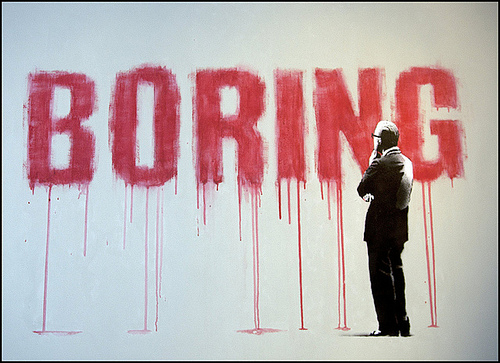
  • Is Your Church Boring People with The Gospel?

    He’s only twelve years old but he convinced his whole family to try a different church. After spending the night at our house one weekend, Josh attended a service at the downtown campus of Cross Point Church. He sat quietly through worship and teaching but afterward spoke his peace “wow, I wish my church was like this. It’s so boring and I hate going.” Weeks went by and Josh visited again with us. Three weeks later, he was back. This time with his whole family: mom, dad and older brother. They sat next to us and left the service with big smiles on their faces and these parting words, “we will be back!”

    Is Your Church Boring People with the Gospel?

    I love my church and I’m definitely biased about what happens there, but I also know the congregation Josh and his parents use to attend. I understand their feelings. When was the last time someone bored you with the gospel? To me that’s inexcusable.

    I’m not talking about worship or teaching styles. I’m not comparing traditional with contemporary, electric guitars with pipe organ. I’m making a contrast between a life-giving worship experience and an energy-draining service. I’m making the case for a place where success in your Christian walk is measured by life-transformation instead of only knowledge of biblical facts.

    I’ve been to dynamic churches in the entire stylistic spectrum. However, they all have the same ability to engage both the heart and mind, to connect faith and life in a relevant and powerful way. I don’t know about you, but I no longer want to go through a service and say “I learned a lot today.” That’s not enough. I want to look back and say “something happened today and I’m changed.”

    What would Josh say if he were to visit your church?

  • The Day I Lost My Life (or My iPhone)

    Yesterday I panicked like I haven’t panicked in a long, long time. As a matter of fact, I can’t remember feeling so lost and out of sorts like I did at the Orlando airport. Most of the time,  I’m very decisive. When things don’t go as planned, I usually have a plan B or C ready to deploy. But that was not the case yesterday. As I walked away from the Hertz rental car return into the terminal, I realized that my iPhone was not with me. It took me all of 5 minutes to notice it was missing. But it was too late. A worker had already taken it from the rental car and kept it. Suddenly disbelief, loss and sheer terror joined me as I raced across the airport trying to not to lose my flight since I had already lost my life, uh, I mean, my phone.

    The Day I lost my Life or My iPhone

    Thankfully I had my iPad with me and I was able to email, Facebook and tweet about appointments I was going to be late for since my flight was delayed. Three hours later, thanks to my Mobile Me subscription, I had a new iPhone complete with my apps and contact information. It was only then I was able to think of anything else. Anything at all.

    The panic I felt was real. At one point I thought I’d rather lose my wallet than my cell phone.That’s when I realized that I might have a problem. Could I live without my cell phone even for a day? Of course I could. But boy, you wouldn’t want to be anywhere near me during that time. My iPhone is as much a part of me as my gall bladder is, but way more important, I might add.

    I have realized that technology is no longer something we use; technology is a part of who we are. Our smart phones carry within themselves the very essence of each one of us: access to our friends, our jobs, phone numbers, text messages, appointments, pictures, movies, banking information, our favorite music and even the recipe for your favorite dish. How can we ever live without it?

    What’s the longest you’ve ever been without your cell phone? How did you do?

  • Are You a Gracious Person? I’m Not Sure I Am

    There’s nothing more refreshing than a gracious person. I have spent the past two days playing golf with pastors of very large churches at Bay Hill in Orlando, Fl. And for those of us who have to work hard and can’t play golf regularly (I’m just bitter because of the sad state of my golf game), a gracious partner during a round is truly a gift. During this trip, I have been fortunate to play with gracious men. They were kind, encouraging, and allowed me to bend the rules of golf, which if you’re not aware, are many. (I’m convinced that golf rules were written by the Pharisees.) But as I enjoyed being the recipient of such grace, I have reflected over my own past. I’m not sure I have always been a gracious person. As as matter of fact, I’m not sure I am one today.

    ARe you a gracious person, Really?

    The question today is a simple one: What makes someone a gracious person? Consider these:

    A gracious person is accommodating. Often they will inconvenience themselves to make others comfortable.

    A gracious person minimizes consequences. How upset would you be if someone dragged mud through the house and stain your favorite rug or spilled coffee on your favorite shirt? They will make you feel ok when you know you have screwed up.

    A gracious person engages. They can listen intently while someone goes on and on about something trivial or uninteresting

    A gracious person shares. It’s their last cookie or protein bar but they’ll break it in half and share it with you before you even ask. But they also share their home, their resources and their hearts with those around them.

    I can’t speak for you or anyone else, but I’m pretty convicted about being more gracious. It’s always easy for me to be on the receiving end of grace, I’m not proud to say.

    What other attributes is the list missing? Who is the most gracious person you know?

  • What’s Your Church’s First Message?

    We all want to believe we are friendly. I’ve never been to a church that said, “we’re not friendly.” Well, I take that back. I once visited with a minister who said “we’re not a very friendly congregation.” And boy, he meant it. But usually churches I work with are evangelical protestant congregations with a heart for those outside the faith. Such churches want newcomers to feel welcomed and go through great lengths to create environments that say, “we’re glad you here.” But sometimes there’s a disconnect between what happens inside and what people see on the outside.

    Recently I saw this sign outside a church’s front door:

    Unfriendly Church Sign

    In principle I don’t have a problem with a church not wanting people to eat, talk on the phone or even chew gum. Ok, I have a problem with not being able to chew gum at church. But should that be the first message someone new to your church sees? Is that the most important thing you want to tell a person outside the faith before they even get into the building? Come on, now.

    Churches can spend a lot of effort and money on special services, websites and marketing materials only to have a small, ill-conceived sign ruin the experience for someone new. You might see it as an inconsequential detail. I believe it’s a consequential fail. When was the last time you walked around your church building with someone new and really took inventory of what you’re communicating?

    Am I being over sensitive? What’s the first message someone new “sees” as they come to your church?

  • Fast Forward Deployment and Your Online Project

    The social media revolution has forced traditional journalism to rethink its most basic premise: a well researched, well developed and thoroughly checked news story. We don’t want to wait for weeks or even days for a news story. We want it within hours of it breaking, minutes would be best.  Journalists have even coined a new name for it: fast forward journalism. It’s a fast, unstructured post, and with just the facts that are available at the moment, giving its audience enough information to get them up to speed. I believe online development needs its own fast forward approach.

    Fast Forward web develepmont

    Not long ago I sat in a room filled with engineers working on a spec document for an online tool. We worked for a solid week. The engineers were trying to account for every potential user scenario and exception. I was fighting for simplicity and quick deployment. I had not given my process a name yet, but I’m calling fast forward development.

    The reason start ups are more likely to create tools we love to use is because they often start with a simple idea and deploy it quickly, cost effectively and then allow users input to change and grow the product. Facebook is a great example of something that started small and focused (Harvard students only at first) then grew to other schools and now has over 500 million members.

    Too often we take our analog reasoning into a digital project and kill it before it even has a chance to live.

    Whether you’re developing a new website, an online ministry tool, or an e-commerce solution, consider the following:

    What’s the absolutely minimum number of features this project  should have? The wisdom here is to create a tool that is useful but it has no more than it needs to have for a successful launch. If you don’t give your users enough, it will fail. They will not check back to see if you have finished the site. If you try to give them too much you run the risk of scope creep, timeline delays, costs overruns–and all of it before your target audience has a chance to tell you that your most resource-intensive feature was not worth the extra time and money.

    How fast can we launch? Currently my team at The A Group is working on a few large and quite complex projects. But even on these projects we timeline weeks of development as opposed to months.

    Digital platforms are alive and they can, and should, change often. The sooner we realize that there is no perfection when it comes to the digital domain, the sooner we’ll become effective software developers. Technology, attitudes and opportunities chance fast. In order to be relevant and even survive, so should your program.

    What do you think of the “fast forward development” approach?

  • Friendship Blinders Could Cost You a Lot

    You probably have all the friends you “need” in life. Perhaps if you have even more of your share of close relationships and you cannot even manage the ones you have well. So, if you’re like most, you go on about your life with relational blinders on. No, you’re not rude or aloof, but you unconsciously developed the attitude that communicates, “while you might be a nice person, I’ve gotten all the friends I need.”  I wish you would reconsider.

    Your Friendship

    When you allow your story to intersect someone else’s story in a meaningful way something special happens. I believe God brings a new friendship into our lives sometimes for a short season, sometimes for a lifetime to enrich both lives. When we fail to seize the opportunity to engage someone new, to ask a second question that will lead into a longer, more meaningful conversation, and we retreat into our overly scheduled lives, we miss out on a blessing. Some of the people whose lives have deeply impacted my own I have met in chance meetings where I could have easily missed the opportunity to engage. I’m so thankful I didn’t.

    Today as you sit in church or go about your business I want to challenge you to be aware of the people God places in your path. This is not about being an extrovert, seeking out every new face you run across and making small talk. But I want you and I to be present, to live in the moment, engaged. I want to be able to look people in the eye and realize that their story might be part of mine, to be aware that the stranger I have just met, could one day become a dear friend. After all, a stranger is just a friend we have not yet met.

    How hard is for you to make new friends?

  • Not All Blessings Are Created Equal

    I didn’t grow up with thanksgiving day as a holiday. Christmas season in Brazil officially begins sometime in early November and goes on until January 6, Kings’ Day. Yes, that’s traditionally the day the Catholic church celebrates the Magi arriving in Bethlehem. But growing up,  Thanksgiving day celebration was relegated to a couple of children’s choirs singing at a local mall and a blip on the news. Brazilians are missing out, and as I stopped to take inventory of all my blessings today, something stood out on my list.

    Thanksgiving 2010 Maurilio Amorim

    This morning I joined several friends early and ran the Boulevard Bolt, a 5-mile race through Belle Meade Boulevard, my familiar running route. I rushed home and cooked a 22 lb turkey, 12 lbs of mash potato and lots of other goodies to celebrate with family and friends from far and near.

    As I prayed before the bounteous, tryptophan-laden and coma-inducing meal began, I was reminded of my blessings. But with all the abundance around me, I’m most thankful for the people God has put in my life. While I’m so appreciative of all the material possessions and comforts I have, my family and friends are what make me smile and look forward to getting up another day.

    I even have friends I have not yet met face-to-face whom I feel a bond to. I know that sounds weird to some, but I consider some people I’ve met online as true friends. I really do.

    There’s a lot of things I cannot do, but in my limitation, I can be a friend and a thankful one. So, to my friends reading this post, I’m thankful for you, wherever you are.

    How was your thanksgiving? What did you do ?

  • Owning My Own Issues: A Confession

    Yesterday was a very busy, challenging day for me. I don’t know if you can relate to the type of day that seems to be hard to get through. It’s the kind of day that you realize you might just have too many plates up in the air and that some might be crashing soon. There were too many loose ends, too much ambiguity in the projects I was involved in, and not enough joy to celebrate the victories. Sounds like fun, doesn’t it?

    Owning my own Issues

    So this is not a “how to” blog. It’s just a confessional post.

    I’m going to own the responsibility for my crazy busy, joyless day. Maybe I’m over committed, or not sleeping enough, or not eating enough, or not eating enough of the right stuff, whatever. I’m not sure yet what the answer to my dilemma is, but I’m going to figure it out, and soon.

    But here’s what I’m not going to do. I’m not going to be in a bad mood and take it out on those around me. That’s usually what I do. I get hyper critical, irritable and question everything and everyone. It doesn’t happen often, but when it does, it’s not fun, I hear.

    So, I’m writing this for myself and for those who have to deal with me today.

    If you see me getting crabby today, please remind me of this post.

    How do you deal with frustration?