Category: business

  • Your Marriage, Your Career

    I have been thinking about some of the business advice I have given lately to clients and friends. One in particular sounds out of place. It doesn’t fit neatly in the “business” category but in my experience it has more to do with business than most any other nugget of help I have both given or received from someone. Perhaps the greatest impact in my business career has been whom I chose to marry.

    Your best business move might be whom you marry

    I cannot tell you how fortunately I am to have married well–“Way out of your league” as a friend once reminded me. This personal decision has had a greater impact in my business career than any other single choice. Being married to Gwen has allowed me to pursue my dreams to a degree I would never had done alone, and much less if I had married a lesser person. Marrying well will:

    Provide encouragement to to pursue your dreams

    Give you the confidence to move forward

    Create a safe place you call home

    Bring balance in an ever-demanding world

    Love you for who you are, so you can be all you’re destined to be

    But the opposite is also true when we choose poorly and find ourselves in a relationship that

    deflates,

    demands,

    mistrusts,

    and doubts.

    Sadly, I’ve been around brilliant men and women who cannot pursue their God-given dreams because they live in the throws of relational chaos, trying to manage a difficult relationship while letting life’s opportunities slip away.

    I hope you’re reading this and thanking God for your spouse. Perhaps you’re single and considering your options. For some, this post comes too late. Maybe some can make a case of being able to succeed in business despite their difficult marriages, but I can only imagine the extra amount of energy it would take to make that work. And how much more could they accomplish if they had a safe, encouraging place to call home?

    How’s the most significant relationship in your life affect what you do?

  • Bad Leaders and the Curse of Happy Talk

    Good leaders are good communicators. There’s no way out of it. Happy talk is their way of casting vision but not accomplishing much.  One of the primary functions of a leader is to sell a vision, a destination, or a future to his or her followers. You can’t do that without good communication skills. But a good communicator is not necessarily a good leader. While your oratory skills might get you elected to a prestigious position, it will not keep you there long. I have been in so many meetings led by a good communicator who happens to be a poor leader. Most of goes on in these settings I call “happy talk”: the ability to talk about ideas, projects and initiatives that will never materialize. Chances are, next time the same people convene, some, if not all, of the same subject matter will come back up for discussion again. Happy talk will ensue but nothing will get accomplished afterward. Here’s sure signs you’re sitting through a happy talk session:

    The leader’s ideas are grandiose but not rooted in reality. That usually happens when the leader’s idea so far outside the current scope of work and experience that it cannot be accomplished with the available resources. People will listen mostly because they’re getting paid to be at the meeting. You know you’re in the middle of a grandiose speech when you’re thinking “that will never happen.”

    There is little or no conviction. The moment someone else in the room question the idea, the leader drops the discussion and moves on to another subject or topic. The leader is not comfortable with conflict and instead of working through the issue, it’s easy to just drop it altogether. Doers need to see how all the dots connect, before they can jump in and embrace a new idea. After all none of us want to get stuck with a project we cannot figure out how to implement. Weak leaders confuse the need for clarity with paralyzing conflict.

    There are no implementation goals or time lines. I’ve been in meetings where a new idea is presented by a leader but after hours of “vision casting” we walk out of the room without specific goals, dates and tasks. In my experience, if you don’t have a due date a set of goals and a way to measure a win, chances are nothing will be done until the next time you gather again for another round of happy talk.

    What’s your experience with happy talk?

  • Sometimes You Need a Fresh Perspective to See the Obvious

    As a consultant, too often, I feel I’m telling my clients the obvious. After all, it doesn’t take me long to figure out what they should do next. I forget how immersed I am in my professional career and how much it has become second nature to me. In my years of consulting I have learned that there are three key components to helping a person or organization: expertise, experience and perspective.

    Sometimes you need a different perspective

    I tell my clients that they are not paying for my time, but for my expertise. If you’re going to be helpful you have to understand your professional arena well, and expertise that’s paired with experience is a powerful combination. Expertise tells you that A + B = C , but experience knows that if you don’t start with B first and then add A, your C will not be good. Experience gives context to expertise and produces real-life applications.

    While most people agree with expertise and experience being cornerstones of good counsel, some forget how important perspective is. Perspective is what helps you see the forest and not just the trees, and it’s perspective that helps you see the big obvious problem, while your client only sees the broken pieces caused by the real issue. Perspective brings fresh eyes to a tired situation and helps people see the elusive obvious.

    I was reminded of that last week when getting a hair cut. I told the new  hair stylist, “I have this callick and I can’t get my hair to lay down. What product do you recommend?” He looked at it for a minute and said, “have you ever combed it the opposite direction?” That was the most obvious of all questions. And the answer was “no. I’ve never even considered it.”

    When was the last time someone brought fresh perspective in your life or business? What happened?

  • Are Non Profits Dying Because They Don’t Pay Well?

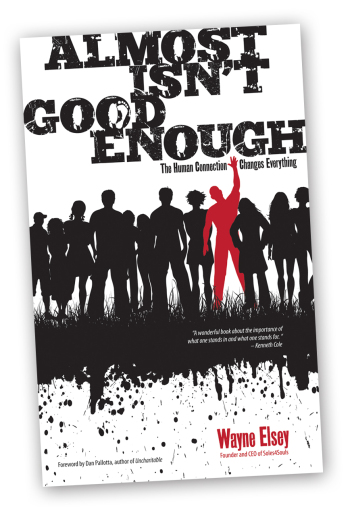
    My friend Wayne Elsey is an extraordinary guy. He has built one of the most successful non profit organization in the world. During the last 5 years, Soles 4 Souls has gone from 0 to over a 70-million dollar annual budget organization. I’m thankful to have been a partner from early on. My company, The A Group, has developed soles4souls.org and their online fund-raising site. Wayne has written a book I believe every leader should read, “Almost Isn’t Good Enough.” This is not only his story of starting and growing S4S, but a very practical tool for business and ministry leaders everywhere. Chapter 2 has stuck with me, and I can’t get it out of my mind: Build the Community You Want, Not the One You Can Afford.

    According to Elsey, finding the best people for the job and hiring them at competitive wages (competitive with the market place and not other non-profits) is key in building a high performance organization. If you want to make an impact, find the best and pay them well.

    That hasn’t been the norm. Usually we find good people and offer them a lot less to work for “a job that matters.” So their choice is either to work for good money at the market place or work for peanuts in ministry or for a not-for-profit. Most heads of ministry justify their low wages on the basis of donor expectations, citing that their donors would be upset if they paid competitive wages. That’s not how Wayne sees it:

    I’m growing weary of the long-winded, ill-informed conversations about what donors care about and what they don’t. Donors are not upset and outraged by how much people are paid. Donors want impact, results, and the opportunity to make a larger footprint through your cause or organization. What donors react to negatively is when the lines of expense and impact have been crossed and the net result is more expense than impact.

    I think he’s spot on. I tell my clients often that something is only expensive if it doesn’t work. I don’t care how much it costs. A low-wage, low-performance employee is not a cost savings. He’s a liability. I don’t think S4S would be giving out a pair of shoes every 7 seconds if Wayne had surrounded himself with well-meaning and yet low-capacity employees.

    How do you feel about ministry or not-for-profit paying competitive wages to their employees?

  • Ambiguity and the New Business Normal

    The pace of change has picked up. Not only is the world flat, the world adopts technology, new standards at a much faster pace than ever before. Just look at what Google and Facebook have done for business and cultural expectations. Yesterday Facebook introduced a new profile feature and Google introduced an ebook store. Millions of people immediately adapted and adopted the new options. As a matter of fact, we have come to expect this kind of dynamic change. This fast pace has created a lot of opportunity for some and has been the demise of others. To me, this new business model is defined by ambiguity.

    Ambiguity is the New Business Plan

    What does that mean? It means that as a leader I still need to know where I want to take my organization, but I no longer have the luxury of planning my trip all the way to its final destination. Along the way the road might turn right, left or not at all, but I won’t know it until I get further down the road.

    Do you remember the 5 and 10 year plans? I do. I went through a lot of them. Today they are a big waste of time. If you’re going to survive this new faster race, you will have to be able to adapt and do so quickly. Once upon a time business plans plotted the course from A to Z by connecting all the dots and creating a linear path through the business alphabet: A connects to B that connects to C and so forth. In the new economy A connects to B and C might be something completely different that it was a few months ago. As a matter of fact, C might not even be there at all. Unless you’re able to, not only live with ambiguity but also embrace and anticipate change, you’re going to be left behind.

    What are the implications for businesses, churches and ministries? More than ever before, organizations have to know who they are and what they want because the “how” of their plans will be a continuously moving target. This can be frustrating to a lot of people, but it’s also exciting and dynamic for those who learn to embrace change, try new ideas and discard systems that stop delivering.

    The cost of inertia has just gone up. Way up.

    How do you feel about leading and working with uncertainty and ambiguity? Are you experiencing that in your world?

  • Before You Make a Career Change

    More than any other time in my career, I have had more people ask me how I started The A Group. These are entrepreneurs who for a variety of reasons find themselves in transition. Look around you. A lot of us are in transition right now. Jobs are going away or morphing into something completely different than you signed up for. Jobs that were profitable a few years ago, are disappearing today, so now you’re re-evaluating your options. If you’re considering a career change, here’s a few thoughts.

    Considerations for your new career Maurilio Amorim

    Be honest with yourself. Yes, the recession has wreaked havoc in the job market, but it’s easy to blame the economy on our bad job performance or misaligned career choice. Ask yourself, “even if times were good, was that the best job for me?” A good friend came to a sober and yet liberating realization recently. He decided that his career path was not a good fit for his skills and personality. The tough job market forced him to rethink his choices and make a change that potentially would have taken much longer to make and keep him from personally fulfilling work.

    Remove old labels. What worked in a now failed economy or industry most likely will not work in the new one. Don’t try to use the language of yesterday to created the position for tomorrow. I wrote a post about that here. Think about what you can offer, deliver, fix or create for someone or organization. What need do you see in ministry or in the marketplace that you can meet? When the rules change, there are always new opportunities that arise. Design your new business or position based on the new opportunity. No matter the economic climate, if you can deliver value, you’ll always have business.

    Your self worth should come from who you are and not from what you do. The argument usually goes like “but I want to do work that matters, something that makes a difference.” While I understand the sentiment behind the words, I think we might be missing the boat here. Sometimes work done well allow us to find time, resources and tools to serve, give and do ministry. Somehow we have shifted our cultural status quo ideal from a highly lucrative work towards a socially-conscientious, environmentally-friendly and animal-protecting job. But as Christians, our value and personal fulfillment should come from our view of God and His value of us and not from what we do.

    We have replaced money with social conscience. While it sounds more noble, it’s no less wrong.

    What trends have you notice in your profession?

  • Red Flags Your Business Relationship is in Trouble

    The most important work I do as a consultant is to help my clients with strategies in communications, business systems and even creative output. A lot of very cool tools and initiatives come from the work and many of these, my company, The A Group, gets to produce.  Recently during an interview, I was asked: “in your consulting work, what are the red flags your deal is in trouble?” It’s not a hard question to answer, but it’s a painful place to be. Whether you’re a consultant, a freelancer, an employee or a partner, the following red flags could mean your deal is in jeopardy:

    Red Flags about your business deal Maurilio Amorim

    • Communication Blackout. Your emails, phone calls, text messages and even Twitter direct messages are not being answered in a timely matter or not at all. When people “go under” often means there’s trouble ahead. You better figure out what’s causing it before the deal is completely derailed.
    • Justification Inquisition. There’s a healthy amount of information your client needs about what you’re doing, especially if you’re charging them by the hour; however, when you hear something like “I need everything you’re doing for us documented,” brace yourself. Usually this comes about not because your client wants to send you a thank you note for all the hours you’re working on his projects. Trust has been lost and your work is under scrutiny.
    • Internal Teamer. Someone figures out they can replace you with an internal position for less than what you cost. Even though it hurts being replaced, sometimes that’s the best thing for your client. A lot of times it’s a bad move for them. They might get cheaper labor but they often discount the true overhead cost of a new hire and the lack of expertise and objectivity they bring to the job.  Play nice. I’ve seen clients do a 180 once they realize that the internal position was a bad idea. If you don’t burn bridges, then they’ll come back to you.
    • More for Less. Times are tough, so now you’re asked to lower your fees and increase your output, because, well, times are tough. If your margins are healthy and you want to make concessions, that’s an acceptable compromise, but the moment you devalue your work to hold on to a demanding client and acquiesce to an unreasonable request, you have embarked into a non-returnable trip.  Your client will depreciate your work while you risk losing money in hopes you can return to a profitable position sometime soon. But you never will.

    In your experience what other red flags have you seen before a relationship went bad?

  • You Need a Heart for Business

    The man to my left leaned in and with intensity in his eyes asked the question: “I’m contemplating a strategic business partnership; I want to lead my business into outliving me.” Across the table from us sat a veteran CEO with years of experience in multi-billion dollar business. The answer surprised me, but, again, it should not have. The delivery was deliberate and the words were kind but firm: “Check your heart. What kind of person do you want to entrust your clients to?”

    business strategy heart Maurilio Amorim

    For some, this is the kind of answer you expect when one searches for a mate at a dating site. I cannot get passed that statement because it resonated with me in everything I’ve learned about business. Yes, business. A flood of thoughts with tangled emotions attached to them are still swirling around my mind as I think about the times I “checked my heart” and went against the status quo, or the times I ignored it and went with just the business bottom line.  I’ve never regretted trusting my feelings.

    If you don’t lead with your heart, you’ll run the risk of being deceived by your mind.

    I’ve been in meetings with potential partners or clients where my feelings spoke a different, dissonant message than the potential profit number at the end of the spreadsheet:”great numbers, but do you respect and believe in this person?” After so many years of failures, some monumental and costly, by choosing the wrong answer, I am learning to listen and trust my heart in the matters of business more and more.

    Interestingly that happens in ministry as well as in business. Everything looks great on paper, references and interviews all have gone as well as they could, but there’s still a murmur in your heart and you are not at peace. Listen to your heart.

    Are you in a place where your heart is saying something different than your mind?

  • Are You Ready for a CSO? (Chief Social Officer)

    A few years ago, social media was mostly an annoyance to most businesses IT directors who tried to keep employees from accessing social networks during working hours. Well, that still goes on today. However, most organizations have began tapping into the power of online communities. Dell has made millions from its Twitter account over the years and that number continues to grow. It’s hard to find any organization without a Twitter account or a Facebook fan page. But as social media has grown and developed has your online strategy grown as well?

    Are you ready for a chief social officer Maurilio Amorim

    Fast Company’s latest issue features an article on CSOs (Chief Social Officers). These are not interns who “play around” the internet for companies such as Ford and Virgin Atlantic. These are highly skilled, highly compensated professionals who are setting strategies and directing teams to harness the power of online networks.  So if you haven’t taking this thing seriously yet, you’d better wake up. And Soon.

    If you’re thinking about taking your social media strategy to the next level, and perhaps hiring or creating a position, even a CSO, here are a few things to consider:

    Find someone who likes people. Social Media is a conversation, not a monologue. Success here means more than just messaging. It’s the most important customer initiative you will probably ever undertake.

    Find someone who’s already doing it well. You can empower, train and grow talented people much easier than you can train someone who might never perform to the level you need. I’m not convinced you can even train people to do social media well. Do yourself a favor and recruit someone who’s doing it already.

    Find someone you trust. Social media is messy. Even the best of conversations can go awry and your CSO and her team will be your voice at the front lines. If you don’t trust them to speak for you,  then don’t hire them.

    Find someone who cares. Conversations begin at all times including night and weekends. This is not a 9-5 job. If you’re not part of an important discussion about your organization when it happens, then you miss the opportunity to make an impact. In my experience, you cannot teach people to care beyond the work-day clock. They either do or don’t.

    What’s the next step for your organization’s social media strategy?

  • Is Your Team Blocking Your Opportunity?

    It’s happening all over the place: leaders are hijacking critical projects from their internal teams and implementing a “bypass” play in order to get things done. While you might question the non-conventional leadership style, the wisdom or the potential fall-out inside the organization of such tactics, these leaders are more worried about missed opportunities, missed revenues or loss of ministry impact than trying to protect the organizational pride and inefficiency.

    Leadership Development Is Your Team Blocking Your Opportunity? Maurilio Amorim

    Lately, much of my consulting has been with key leaders who find themselves in endless meetings, studies, and discussions of projects that have been stalled for months and even  years because of organizational inertia. As leaders they see the opportunity and want to seize the moment, but cannot make forward progress with their teams.

    Fear, incompetent, ignorance, philosophical differences, and so many other issues often play into this organizational paralysis that keeps a lot of good businesses and ministries from making a strategic move. However, in my experience organizations have a window of opportunity in which to leverage a new technology, a new venture  or a potential outreach. But then enters the obligatory company buy in. And trust me, I understand the need for the widest acceptance possible, but sometimes that’s the kiss of death. I’ve sat in meetings where I knew the project at hand would never get done: too many people, too many opinions, too much fear. Somewhere along the road, leaders have bought into the idea that they lead a democratic organization and if the majority is not excited about a project, then they will not pursuit it. That’s bad thinking.

    If  as a leader, you cannot dismantle the machine and start over, then it’s time for your “bypass” play. Here’s what I’ve seen work:

    • Keep your team as small as you can: two to three people is ideal
    • Make your scope focused and manageable. Think delivery in weeks, not months.
    • Understand the project’s critical mass: What’s the minimum we need to make this work.
    • It’s more important to deliver it fast than to have it fully right. Trust me on this one. Nothing is perfect. People remember the first in a class, not necessarily the best.

    Take inventory. What project or initiative you have been trying to get done that has dragged on and on? What about something cutting edge that you just know your people will torpedo it before it even gets born? Maybe it’s your bypass time.

    If you could call a bypass play at work, what would you do, or create?