Month: December 2010

  • How Generous Are You?

    I remembering seeing an episode of the Celebrity Apprentice where Sharon Ousborne was thrilled she was able to secure a 15 thousand dollar gift from a wealthy donor. She was ‘shocked’ because according to her, she had never seen anyone give that much money away before. Well, I was shocked but for a different reason. First, her reaction told me a lot about Mrs. Ousborne generosity quotient or lack thereof and then it reminded me how many truly giving people I have met over the years. People who have given a lot more with a lot less money. So during this giving season, what does it mean to be generous?

    How Generous Are You

    Here’s a few thoughts about generosity:

    It’s not an amount. a 15 thousand dollar gift might not be as generous as a 15 dollar one.  Remember the story of the widow’s mite?

    It’s not about money. Sometimes your most generous gift is one of time and friendship. I’m at a stage in life that I really don’t need more stuff. But I can always use the company and counsel of a good friend.

    It’s a choice. Much like any human virtue, a generous heart is cultivated and not born.  Left to human nature,  we all would be greedy and selfish.

    It’s a responsibility. I believe that the Bible means business when it says that to whom much is given, much is required. I was reminded of that passage of Scripture by a friend who has given much of what he had away and has such a gracious heart.

    It’s a blessing. I have never, ever regretted being generous. Every time I give, I always receive more than the value of the gift back, and not from a “giving so I can receive, name-it-and-claim-it theology,” perspective. I’m blessed in ways I could never orchestrate or predict.

    Did I miss anything? What else would you add?

  • Sometimes You Need a Fresh Perspective to See the Obvious

    As a consultant, too often, I feel I’m telling my clients the obvious. After all, it doesn’t take me long to figure out what they should do next. I forget how immersed I am in my professional career and how much it has become second nature to me. In my years of consulting I have learned that there are three key components to helping a person or organization: expertise, experience and perspective.

    Sometimes you need a different perspective

    I tell my clients that they are not paying for my time, but for my expertise. If you’re going to be helpful you have to understand your professional arena well, and expertise that’s paired with experience is a powerful combination. Expertise tells you that A + B = C , but experience knows that if you don’t start with B first and then add A, your C will not be good. Experience gives context to expertise and produces real-life applications.

    While most people agree with expertise and experience being cornerstones of good counsel, some forget how important perspective is. Perspective is what helps you see the forest and not just the trees, and it’s perspective that helps you see the big obvious problem, while your client only sees the broken pieces caused by the real issue. Perspective brings fresh eyes to a tired situation and helps people see the elusive obvious.

    I was reminded of that last week when getting a hair cut. I told the new  hair stylist, “I have this callick and I can’t get my hair to lay down. What product do you recommend?” He looked at it for a minute and said, “have you ever combed it the opposite direction?” That was the most obvious of all questions. And the answer was “no. I’ve never even considered it.”

    When was the last time someone brought fresh perspective in your life or business? What happened?

  • Before You Go To Church Readjust Your Expectations

    We love to complicate simple things. The simple bottled water has turned into a multi-billion dollar industry that features flavor infused, protein added and whatever we can find to add in water and sell it. Human nature seem always  to want more, better and bigger. And while this desire to improve on what we have, reach for new heights and possibilities keeps us growing, it also can rob us from the very essence of the simple and foundational purpose.  That’s ever so true on how we have complicated church.

    church worship simple

    This Sunday morning as I’m preparing to go to church, I’m aware of how much we have complicated church as well. I’ve caught myself anticipating the music, the new set, the featured video or even getting my favorite parking spot near the side door more than looking forward to worshiping with my church family or hearing from God. I’ve managed to turn the simple notion of coming together as a church family into a series of “extra features” that have taken main stage.

    So this morning I’m readjusting my expectations. I’m refocusing my attention away from the cultural add ons into a simple encounter with God and His people. I want to encourage you to do the same. Whether you’re sitting in a simple chapel or in a large auditorium with state-of-the-art production, look for the simple and yet life-changing connection with the Creator Himself. All the extra stuff, after all, don’t really matter.

    Do these “extra features” preoccupy you as much as they do me?

  • Growing Love in Your Kids at Christmas

    Guest post by Dr. Tim Elmore

    Love. We probably talk about this concept more today than ever before, but actually practice it less than ever. At least in the way God intended us to do so. We find love in movies, romance novels, in Hallmark cards, on YouTube, and on bumper stickers. At Christmas time, especially, love is promoted by stores to push sales, and by cinemas to sell tickets. We all love the idea of love!

    But how do we practice it on the people we are closest to — like — in our home? Sometimes, the hardest people to love are not the strangers we meet out shopping, but our own family members.

    Try this simple idea.

    Sit down at dinner one night and talk about “love languages.” You may be familiar with the concept. Author, Dr. Gary Chapman, introduced it to us in his 1992 book: The Five Love Languages. After many years of counseling, Dr. Chapman noticed a pattern: Everyone he had ever counseled had a “love language;” a primary way of expressing and interpreting love. He also discovered that for whatever reason, people are usually drawn to those who speak a different love language than their own. The 5 love languages are:

    1.     Words of Affirmation (Speaking words of encouragement, favor and belief)

    2.     Quality Time (Spending focused time just sharing with another person)

    3.     Physical Touch (Holding hands, offering a hug or a squeeze to express affection)

    4.     Deeds of Service (Finding ways to serve someone by doing something for them)

    5.     Tangible Gifts (Providing some tangible gift that the other person appreciates)

    Allow each family member to discuss which of these is their favorite. Then, have each family member write down their name and what their top love language is. Then, divide them up secretly. Each person should have the name of someone else in the family. The assignment is this: Each person must find a way to “speak” that love language to the person they drew. The following week, talk about what happened.

    Then discuss: How could this be a regular practice in our family, and not just at the holidays but year round?

    “If someone says ‘I love God’ but hates a Christian brother or sister, that person is a liar; for if we don’t love people we can see, how can we love God, whom we cannot see?” (I John 4:20)

    Join us tomorrow at Eric Bryant’s blog as we discuss ways to develop faith in your kids (and maybe yourself!) during the holidays.

    Tim Elmore

    You can follow Tim Elmore’s personal blog at http://blog.growingleaders.com, and learn more about developing the next generation in his latest book: Generation iY: Our Last Chance to Save Their Future.

  • Should I Wear a Hat?

    So what’s the deal with men’s hats? Who should wear them and what style? Hats have been a staple of men’s fashion since Adam decided to wear a nice crown made of bay leaves, so the rumor goes. Some hats are more utilitarian, like Beanies, keep our heads warm during the cold months, even though they have become a fashion statement from gyms to red carpet events. Others, like the Fedora, set men apart in a crowd.  But no matter what kind of hat you decide to wear, it will make a fashion statement.

    While the modern-day hat is not quite as elaborate as its ancestor.

    Here’s a helpful news segment from CBN’s Early Show featuring the Editor of GQ magazine:

    No matter what hat you wear, keep these few rules in mind:

    • Make sure the hat fits your head. Go to a hat store, or one that sells hats, and make sure you’re wearing something that fits well, specially something that’s not too small for your head.
    • Wear light-colored hats during the Spring and Summer and dark during Fall and Winter.
    • If you feel “weird” or not comfortable wearing a Fedora, than don’t do it. If you’re uncomfortable with a hat or any other accessory, people will be uncomfortable with you as well.

    Do you wear a hat? What’s your favorite style?

  • Mannequin Evangelism: A Faith Discussion When You Least Expect

    Yesterday was an interesting day. I spent most of it carrying a mannequin around downtown Nashville in sub freezing temperatures. I carried “Pat,” our androgynous articulated dummy, through busy streets for a video shoot. For this piece, we placed Pat strategically around crowds, street corners and traffic and filmed “life” happening around a stiff, gray representation of a man (even though Pat is technically a woman dummy dressed like a man, but I digress). While I knew people might find the whole scene curious, I didn’t expect it to open the doors for a faith conversation.

    Periodically throughout the day someone would approach me and asked what we were doing. “Do you ever feel like life is passing you by and you’re paralyzed or stuck? People come and go but you’re not moving?” Most just shook their heads in agreement. “This mannequin represents us when we feel stuck and in need of a new beginning.”  As people understood the concept, their eyes would light up as if our foam dummy just came to life and became the actor playing their story in a drama.

    Parker served us lunch and since Pat stood beside the table, he was compelled to ask me what was going on.  I gave him my speech. “I can relate to that,” he said. “Just a few months ago, my life was stuck in a place I didn’t like. Now I’m traveling through America and then through Europe trying to find my way, my path.”

    In that instance, I knew I had an opportunity to share a bit of my faith journey with Parker. “What about your faith search? Are you searching for God as well?” Parker was very open to the conversation, “I’m not religious,” he said and began to describe his past as being raised Christian, but that was no longer what he believed. For the next few minutes I tried to connect him back with a God who loves him and wants to be in a relationship with him. I asked him to be open and honest and ask God to help him find truth and find his way. It was a great conversation, and I pray that God uses my words to impact Parker way beyond our time together.

    Pat taught me something today: if you are an approachable person, people will engage you and give you a chance to impact their lives.  (I didn’t know before today, but if you carry a mannequin around that means you’re approachable–or at least peculiar in a non-threatening way). Truthfully, I probably could have had the same spiritual discussion with most every person who spoke to me during the shoot.

    When was the last time you engaged a total stranger in a faith conversation? Would you do it if I lend you Pat?

  • Are Non Profits Dying Because They Don’t Pay Well?

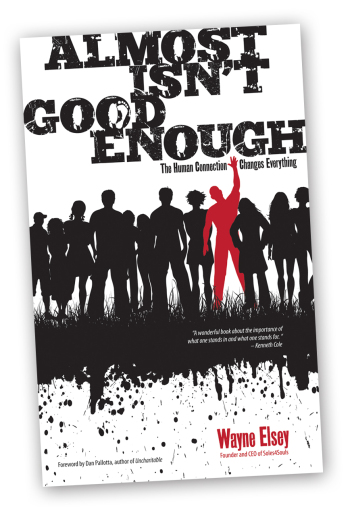
    My friend Wayne Elsey is an extraordinary guy. He has built one of the most successful non profit organization in the world. During the last 5 years, Soles 4 Souls has gone from 0 to over a 70-million dollar annual budget organization. I’m thankful to have been a partner from early on. My company, The A Group, has developed soles4souls.org and their online fund-raising site. Wayne has written a book I believe every leader should read, “Almost Isn’t Good Enough.” This is not only his story of starting and growing S4S, but a very practical tool for business and ministry leaders everywhere. Chapter 2 has stuck with me, and I can’t get it out of my mind: Build the Community You Want, Not the One You Can Afford.

    According to Elsey, finding the best people for the job and hiring them at competitive wages (competitive with the market place and not other non-profits) is key in building a high performance organization. If you want to make an impact, find the best and pay them well.

    That hasn’t been the norm. Usually we find good people and offer them a lot less to work for “a job that matters.” So their choice is either to work for good money at the market place or work for peanuts in ministry or for a not-for-profit. Most heads of ministry justify their low wages on the basis of donor expectations, citing that their donors would be upset if they paid competitive wages. That’s not how Wayne sees it:

    I’m growing weary of the long-winded, ill-informed conversations about what donors care about and what they don’t. Donors are not upset and outraged by how much people are paid. Donors want impact, results, and the opportunity to make a larger footprint through your cause or organization. What donors react to negatively is when the lines of expense and impact have been crossed and the net result is more expense than impact.

    I think he’s spot on. I tell my clients often that something is only expensive if it doesn’t work. I don’t care how much it costs. A low-wage, low-performance employee is not a cost savings. He’s a liability. I don’t think S4S would be giving out a pair of shoes every 7 seconds if Wayne had surrounded himself with well-meaning and yet low-capacity employees.

    How do you feel about ministry or not-for-profit paying competitive wages to their employees?

  • Ambiguity and the New Business Normal

    The pace of change has picked up. Not only is the world flat, the world adopts technology, new standards at a much faster pace than ever before. Just look at what Google and Facebook have done for business and cultural expectations. Yesterday Facebook introduced a new profile feature and Google introduced an ebook store. Millions of people immediately adapted and adopted the new options. As a matter of fact, we have come to expect this kind of dynamic change. This fast pace has created a lot of opportunity for some and has been the demise of others. To me, this new business model is defined by ambiguity.

    Ambiguity is the New Business Plan

    What does that mean? It means that as a leader I still need to know where I want to take my organization, but I no longer have the luxury of planning my trip all the way to its final destination. Along the way the road might turn right, left or not at all, but I won’t know it until I get further down the road.

    Do you remember the 5 and 10 year plans? I do. I went through a lot of them. Today they are a big waste of time. If you’re going to survive this new faster race, you will have to be able to adapt and do so quickly. Once upon a time business plans plotted the course from A to Z by connecting all the dots and creating a linear path through the business alphabet: A connects to B that connects to C and so forth. In the new economy A connects to B and C might be something completely different that it was a few months ago. As a matter of fact, C might not even be there at all. Unless you’re able to, not only live with ambiguity but also embrace and anticipate change, you’re going to be left behind.

    What are the implications for businesses, churches and ministries? More than ever before, organizations have to know who they are and what they want because the “how” of their plans will be a continuously moving target. This can be frustrating to a lot of people, but it’s also exciting and dynamic for those who learn to embrace change, try new ideas and discard systems that stop delivering.

    The cost of inertia has just gone up. Way up.

    How do you feel about leading and working with uncertainty and ambiguity? Are you experiencing that in your world?

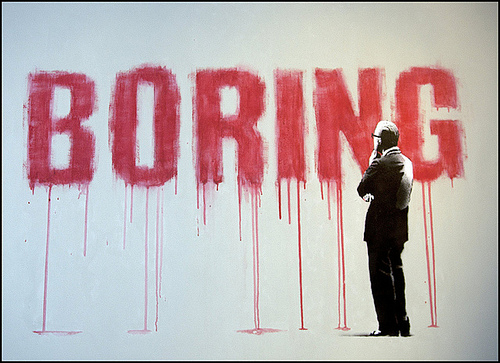
  • Is Your Church Boring People with The Gospel?

    He’s only twelve years old but he convinced his whole family to try a different church. After spending the night at our house one weekend, Josh attended a service at the downtown campus of Cross Point Church. He sat quietly through worship and teaching but afterward spoke his peace “wow, I wish my church was like this. It’s so boring and I hate going.” Weeks went by and Josh visited again with us. Three weeks later, he was back. This time with his whole family: mom, dad and older brother. They sat next to us and left the service with big smiles on their faces and these parting words, “we will be back!”

    Is Your Church Boring People with the Gospel?

    I love my church and I’m definitely biased about what happens there, but I also know the congregation Josh and his parents use to attend. I understand their feelings. When was the last time someone bored you with the gospel? To me that’s inexcusable.

    I’m not talking about worship or teaching styles. I’m not comparing traditional with contemporary, electric guitars with pipe organ. I’m making a contrast between a life-giving worship experience and an energy-draining service. I’m making the case for a place where success in your Christian walk is measured by life-transformation instead of only knowledge of biblical facts.

    I’ve been to dynamic churches in the entire stylistic spectrum. However, they all have the same ability to engage both the heart and mind, to connect faith and life in a relevant and powerful way. I don’t know about you, but I no longer want to go through a service and say “I learned a lot today.” That’s not enough. I want to look back and say “something happened today and I’m changed.”

    What would Josh say if he were to visit your church?

  • The Day I Lost My Life (or My iPhone)

    Yesterday I panicked like I haven’t panicked in a long, long time. As a matter of fact, I can’t remember feeling so lost and out of sorts like I did at the Orlando airport. Most of the time,  I’m very decisive. When things don’t go as planned, I usually have a plan B or C ready to deploy. But that was not the case yesterday. As I walked away from the Hertz rental car return into the terminal, I realized that my iPhone was not with me. It took me all of 5 minutes to notice it was missing. But it was too late. A worker had already taken it from the rental car and kept it. Suddenly disbelief, loss and sheer terror joined me as I raced across the airport trying to not to lose my flight since I had already lost my life, uh, I mean, my phone.

    The Day I lost my Life or My iPhone

    Thankfully I had my iPad with me and I was able to email, Facebook and tweet about appointments I was going to be late for since my flight was delayed. Three hours later, thanks to my Mobile Me subscription, I had a new iPhone complete with my apps and contact information. It was only then I was able to think of anything else. Anything at all.

    The panic I felt was real. At one point I thought I’d rather lose my wallet than my cell phone.That’s when I realized that I might have a problem. Could I live without my cell phone even for a day? Of course I could. But boy, you wouldn’t want to be anywhere near me during that time. My iPhone is as much a part of me as my gall bladder is, but way more important, I might add.

    I have realized that technology is no longer something we use; technology is a part of who we are. Our smart phones carry within themselves the very essence of each one of us: access to our friends, our jobs, phone numbers, text messages, appointments, pictures, movies, banking information, our favorite music and even the recipe for your favorite dish. How can we ever live without it?

    What’s the longest you’ve ever been without your cell phone? How did you do?