Month: July 2009

  • The Right Way to Apologize

    If you’ve lived long enough, you’ve had to apologize multiple times and, if you’re a married man, you’ve done it countless times. But not all apologies are the same. Some people apologize because they get caught and now must find a way clean it up. Others manage to say sorry while shifting the blame to someone else like their employees or to the ever-so-nebulous “unforeseen circumstances.”


    Sunday I had to apologize to my youngest son for losing my patience with him and behaving in a matter that was inappropriate and frankly, wrong. He quickly forgave me and we ended up snuggling on the couch as we watched a movie together.

    As a leader, I have had to make my share of apologies as well. This week I was reminded of how powerful and effective an apology can be by Jeff Bezos, CEO of Amazon.com. Amazon “erased” several books from people’s Kindles that, according to the company, had been uploaded illegally. They clearly mishandled the situation by deleting these purchases and refunding buyers without any notice. However, Jeff’s apology saved the day.

    This is an apology for the way we previously handled illegally sold copies of 1984 and other novels on Kindle. Our “solution” to the problem was stupid, thoughtless, and painfully out of line with our principles. It is wholly self-inflicted, and we deserve the criticism we’ve received. We will use the scar tissue from this painful mistake to help make better decisions going forward, ones that match our mission.

    With deep apology to our customers,

    Jeff Bezos
    Founder & CEO
    Amazon.com

    How have apologies (good or bad) affected you?

  • How Social Media is Changing Communications

    In this 16-minute presentation from TED, Clay Shirky, author of “Here Comes Everybody: The Power of Organizing Without Organizations” makes a compelling presentation on how social media has changed the way we communicate.


    The landscape of information has changed dramatically. Today media is

    • global
    • social
    • ubiquitous
    • cheap

    In a world of media the the former audience is now increasingly full participants, producers. In that world, media is less and less often about crafting a single message to be consumed by individuals and is more and more often a way of creating an environment for convening and supporting groups.

    center http://video.ted.com/assets/player/swf/EmbedPlayer.swf

    Open communication is messy and sometimes painful. What are the implications for churches, Christian organizations that face many critics?

  • Alignment: A Case Study

    I hear a lot about alignment lately. Business and church leaders like to talk about being aligned with mission, staffing, and consumers. It sounds great in meetings. It usually makes people think that you very smart when during any discussion you say “but we must make sure we have alignment here.” Try it next time you’re in any kind of strategy meeting, you’ll feel good. But true alignment is difficult to come by. The road to alignment is often paved with a lot of tough and very unpopular decisions—specially if you’re trying to re-align an organization that, for whatever reason, has gotten off course. Most likely, true alignment comes at the high cost of cancelled programs, product lines, reassigned or terminated staff positions.

    But when it works, it’s a beautiful and inspiring thing to see. I’m thankful to have been part of a true alignment exercise in the past year.
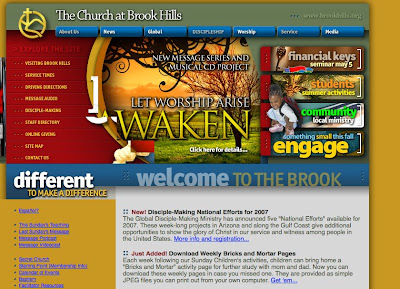
     This is Brook Hills before their branding alignment

    During my first visit to Church of Brook Hills in Birmingham I knew I was walking into a completely different place it had been just a couple of years before. Their new Pastor, 29-year-old David Platt has a passion for world missions and social responsibility and it comes across every time he speaks. Brook Hills had been a great church since its beginning but David brought in a whole different vision than his predecessor. My team’s job was to help Brook Hills bring messaging alignment to David’s vision in the church’s overall communication strategy while Brook Hill’s leadership team worked on their system and program alignments simultaneously.
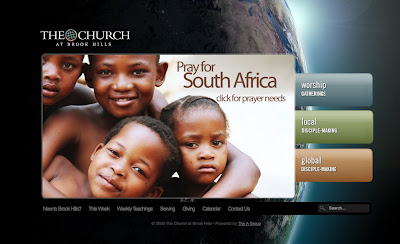
     

    Brook Hills new identity and website

    There were no sacred cows: logo, brand statement, website, all and any church programming. One could argue that this alignment process is never truly finished but we have arrived at a point where visually Brook Hills’ story is being told intentionally at its most critical intersections.

    Brook Hills new logo features an stylized globe and the their three main core values: personal worship, local involvement, global outreach surround it. Their new brand statement: Impact The World, calls for action on both a local as well as global level. According the David’s vision, our calling is not only to reach our community but to reach, teach, and resource people worldwide.

    Brook Hills site’s landing page is a powerful reminder that we’re citizens of the world and the first thing on their rotating feature is a call to pray for a specific country. Every week you can click on the featured country and get stats so your prayers can be meaningful and strategic. I would encourage you to spend some time on their site and explore some of the strategic choices the church made online. Currently BH is working is working at translating David’s teaching series and small group resources in 10 languages of the world in order to resource pastors worldwide with free tools.

     You don’t have to agree with David’s theology or even like him or Brook Hills, (I don’t see why you wouldn’t, however), but you cannot escape the heartbeat of this organization. Their story is being told on every screen, every letter, every service through a strategic and, yes, aligned effort.

     What about your organization or church? How long does it take for a newcomer to understand what you’re all about? Or even long time members?


  • Facing My Own Mortality

    Last week was a difficult one for me. I was confronted with my own mortality through the deaths of several of my generation’s icons, Michael Jackson, Farah Fawcett, Ed Mcmahon and even, Billy Mayes. Farah Fawcett and Mrs. Piggy posters hung side by side in my bedroom wall growing up. I didn’t understand then as well as I do now that everyone dies; well, maybe Mrs. Piggy will live on through eternity, but all of us humans will eventually pass away. But I find myself, like many others in my generation, bucking the we-all-die trend. After all, Suzanne Sommers has me convinced that she’ll live to be 150 and look 35. That’s what I want.


    Interestingly enough, I’m slow realizing that, like the reminder of the recently deceased icons, my own life is just as fleeting. Last Saturday I set out on a long run in the oppressive heat of the Florida summer. After an hour of running, and by the time I felt light headed and began seeing pixies flying around me, I was already in trouble. The onset of what I now think was a heat stroke was already impairing my judgment and I couldn’t decide what to do next. I had enough sense, however, to get into the ocean and try to cool off before I lost consciousness.


    I know that I’m not promised tomorrow here on earth, but often I live like I’m working and living for another day. I’ll put up with the mediocre and keep on plugging in because of the great destination on the horizon. Who am I kidding? Beyond heaven, there’s no destination, only the journey. Life is not a project that at retirement, or some other artificial date will come to fruition. I’ll never hear “You have arrived” at some point during my life like I hear the disembodied voice of my GPS unit saying as I complete a trip.

    I’m going to live forever, but not here. Meanwhile I plan on losing myself in every day I’m given, living, loving, learning until I’m called to be with Jesus. It might even happen at the end of a hot run. You’d never know.